Stepping well out of my comfort zone

I have many friends, some of whom live locally, some who live under 100 miles away, and some who live many thousands of miles away.  I keep in touch with them all on a regular basis.  There are some friends who I have never met in person, but chat to every week via Skype.

All my friends are important to me and I love hearing about their successes, their plans, their daily lives.  I have one friend in Australia who I have known for about four years, and we chat regularly each week via Skype.  Heather lives on a farm in Wangaratta, about 350 miles from Melbourne.  She is a coach, teaches the Romany language, is an artist and an author.  We spend a lot of our time laughing when we chat, and it makes a great start to my day and a good end to Heather’s day (Melbourne is 9 hours ahead of BST).

In April Heather told me that she had been to see some specialists and she has a recurrence of melanomas.  The doctors had told her she had probably got around five months left to live.  Heather of course told them she intended to be around for another thirty years, so not to write her off yet.

She began a course of chemotherapy and I decided to offer my support to Heather in person. That meant I would fly to Australia to be with Heather for a few days.

This decision was not easy to make since I have never travelled anywhere on my own, the furthest I have flown is to Italy (about 2 hours), but it felt right to me.  So I booked my flights out of Heathrow to Melbourne, via Dubai and Brunei.  I was leaving on 15th June at 5.50pm and arriving in Melbourne on 17th June at 4.30am.  Phew! What had I done? Stepped right out of my comfort zone. But it still felt right.

The preparations began.  Because it is winter in Australia I had to sort out jumpers and a coat that wasn’t too heavy.  I was only allowed 20 kilos in baggage.  I also collected lots of brochures and magazines about the Isle of Wight since Heather is planning to come over here in 2016 and these will help her plan what she wants to do when she gets here.

Everything was packed, checked, double checked.  Passport, currency, travel insurance, itinerary, tickets.  Time to go.

DSCN0004

Me at Heathrow Airport

So, there I was at Heathrow airport, having been driven there by my lovely hubby Kelvin.  All checked in and waiting to go through security.  And so the real journey began.  I boarded the Royal Brunei Airlines Boeing 787 Dreamliner, found my seat and then we took off.  The cabin crew were lovely and brought round drinks and food at regular intervals.  6.5 hours later we landed in Dubai.  A quick trip around the airport whilst the plane was refuelled, restocked etc and then we were back on the plane and heading for Brunei.  We landed in Brunei 6 hours later and stopped off for 2 hours.  I wanted a cup of coffee and they only accept their own currency, so I had to change some sterling in Brunei dollars.  Then back on the plane for the final leg to Melbourne.  6.5 hours later we arrived, in the dark in Australia.  The baggage was unloaded very quickly and I sailed through customs and immigration.

I bought a cup of coffee and waited for Heather’s husband Geoff to collect me.  He had volunteered to drive me to their home in Wangaratta, 350 miles away and had got up at 3 in the morning to come to Melbourne to collect me and drive me back.  What a star!

Geoff found me and in about three hours we were in Wangaratta and I got to meet Heather in person. It was as if we were carrying on a conversation, rather than meeting in person for the first time.  We know each other and nothing was strained.  We hugged and the chatting began.

DSCN0013

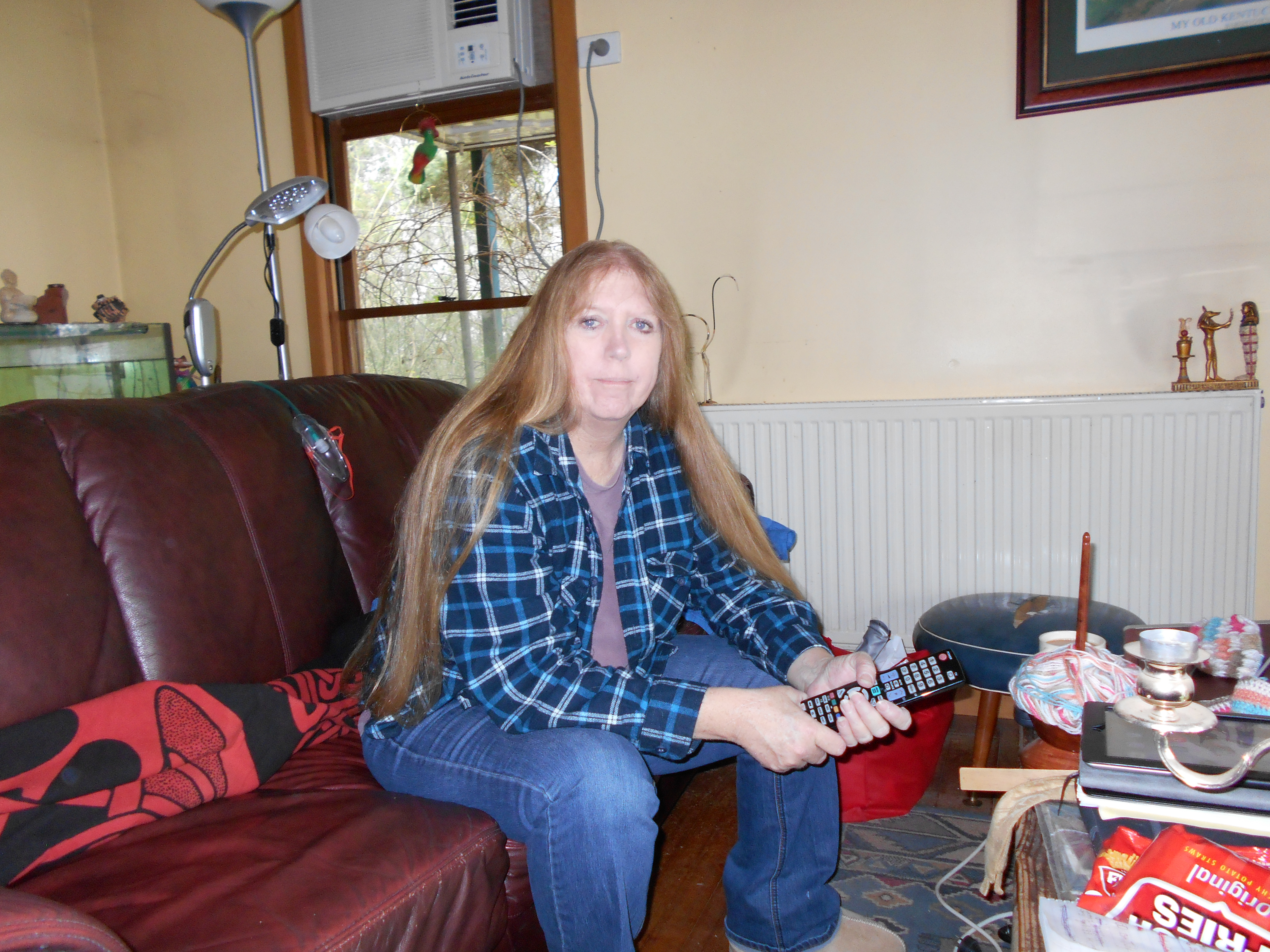
Heather

Heather was half way through her course of chemotherapy and was feeling very tired and weak understandably.  We sat and chatted whilst Geoff prepared meals.  Heather’s friend Susan kindly volunteered to drive us out for an afternoon.  We went for afternoon tea to a place called Beechworth, where they have a wonderful shop that sells honey.  Not just honey, but hundreds of different flavours of honey.  Of course I had to buy some to bring home.  Then to a cafe to have coffee and scones.  Yummy.

IMG00415-20140618-1510

Beechworth

The following day Susan took us out again for afternoon tea to Glenrowan.  I had my photo taken next to Ned Kelly, an Australian bushranger who was apparently very controversial.  We had scones with cream and jam again.  It was lovely to see Heather outside, even though she had to tow her oxygen cylinder with her.

DSCN0018

Me with Ned Kelly

DSCN0022

Heather’s house

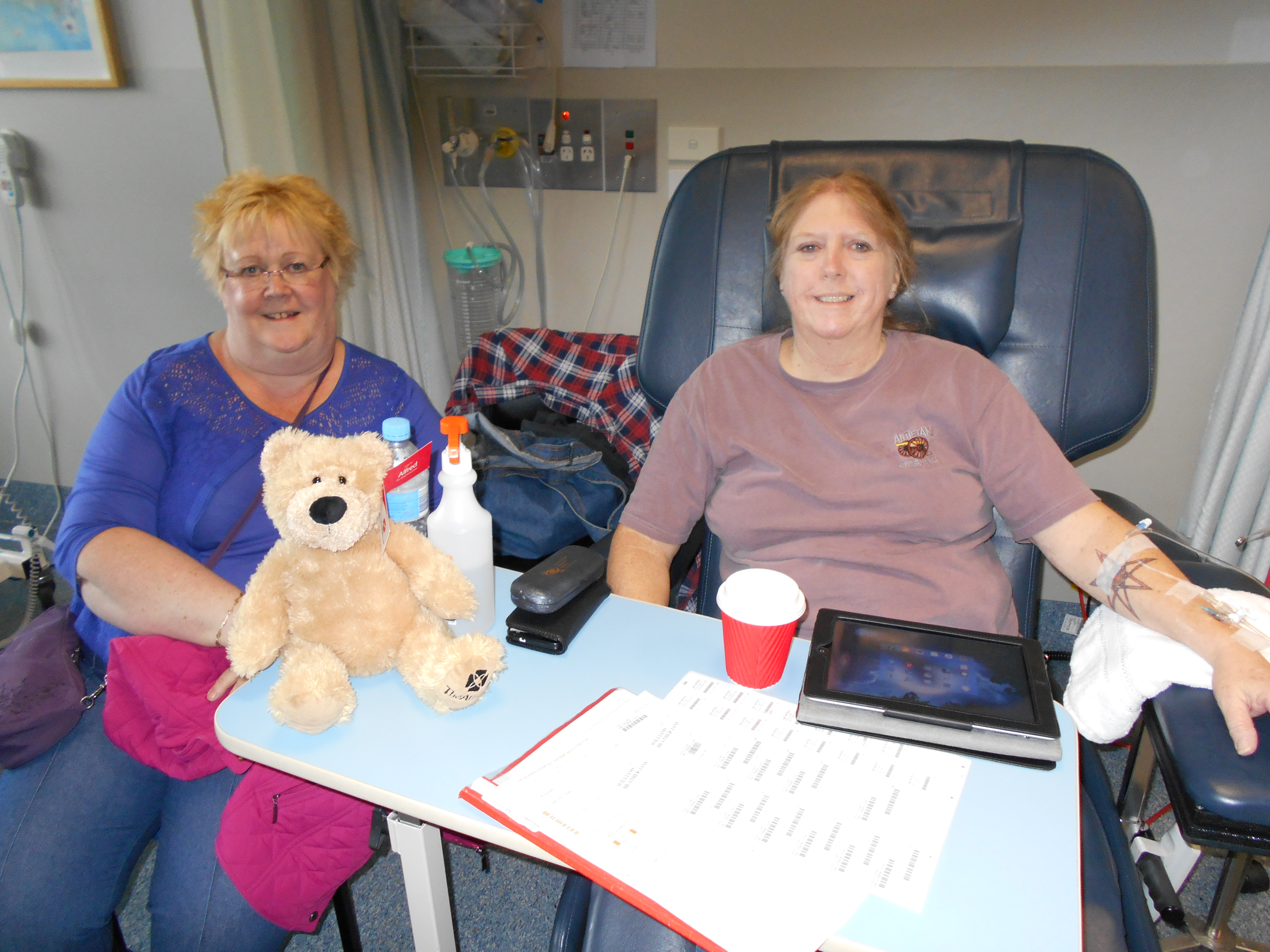
On the Friday we all set off at around 7am to drive to Melbourne again to the Alfred Hospital for Heather’s appointment for her third round of chemo.  We arrived and she was seen by the doctors who were pleased to see her, even though one doctor did express surprise that she was well enough to attend.  (I did think he could have kept that thought to himself).  I sat with Heather and chatted whilst the treatment was going on, ably assisted by Alfred bear.

DSCN0023

Heather and I in the Chemo Unit

That night we stayed with Heather’s son and daughter-in-law just outside Melbourne.  We were fed and entertained by Rhys and Sonia on Saturday too.  Heather was very tired after her treatment and we just sat and chatted, or she dozed in the chair.  We watched a couple of dvds and in the evening we had Chinese takeaway.

Sunday morning we set off again at around 7.30am to go to Melbourne Airport to drop me off and for Heather and Geoff to drive back to Wangaratta.  We said our goodbyes and I began to the check in process at 9am.  I found some breakfast at McDonalds and then went through immigration and security to the departure gate to await my flight.

The first leg of the journey set off from Melbourne to Brunei and took 6.5 hours.  We had a 2 hour stop over at Brunei and I was grateful to be able to walk around and stretch my legs.

IMG00417-20140622-1947

Model of Royal Brunei Airlines Boeing 787 Dreamliner at Brunei Airport

The next leg took me to Dubai, another 7 hours.

DSCN0026

Dubai Airport – Costa gets everywhere!

The next segment of my journey took me to Heathrow Airport where I landed at 6.30am on Monday morning.  I had to wait ages for my case to appear on the carousel, but it eventually arrived.  I then went through the nothing to declare channel.  I was stopped by a customs official and asked where I had been, had I bought any drugs or alcohol, was I carrying anything for anyone else.  All the usual questions.  I said I had bought nothing but some honey.  They seemed  to be ok with that and I went through into the arrivals hall to be met by Kelvin.

Kelvin drove home via Lymington, the Wightlink ferry and home.  I was really happy to be home, but also really pleased that I had made the trip.

I had stepped right out of my comfort zone, but had enjoyed the experience and thoroughly enjoyed meeting Heather and being there for her to support her in some way.  I am looking forward to her coming to visit the Isle of Wight in 2016.

I learned that I am capable of a lot more than I thought I was. I am so pleased that I made this trip.

If you would like to be able to step out of your comfort zone, but are not sure where to begin, contact me for a free chat on how I can help you.


Maggie Currie

maggiecurriecoaching_logo8-2.jpg

Follow me on:

Website

Facebook

Twitter

LinkedIn

Huffington Post

How to break bad habits

What are your bad habits? First you have to identify the habits that you want to break.  The ones you really don’t want to hang to. The ones you consider to be bad habits.

  • Smoking?
  • Talking too much?
  • Drinking?
  • Untidiness?

Whether it’s that perpetual pile of clothes in the corner you’re waiting to someday turn into gold, a self-proclaimed disability which renders you unable to refrain from interrupting, or a knack for timing your exit just so, so that someone else is continually left to do the washing up, now’s the time to extinguish these habits before they turn into next year’s resolutions.

Here are some of the reasons why.

1.      It’s not fair to others. One of the great universal laws ruling our wonderful planet says that you get back what you put out there.

Do you want others to be kind and considerate to you?  Then start putting the considerate, kind vibes out there and pick up your clothes, do the washing up, and stop interrupting or whatever it is you or a collective “others” define as a bad habit.

2.    It’s not fair to you.  I’m sure you’re a nice person, and you pride yourself on having generous, warmhearted traits.  So, it’s not fair to you either that this simple, little, annoying thing you do can wield the power that it now, or will soon have.

These tiny culprits have been known to ruin marriages, friendships, and cause the downfall of many a mighty person.  Plus you’ll feel better about yourself.

3.   Your success depends on it. Bad habits have a funny way of scope and context creep.

First they only happen in certain situations, and the next thing you know, you’re at a business function swirling your fingers through the chip dip. Put an end to it now before situations that require your utmost polish become tarnished by these terribly annoying little monsters.

4.   You probably don’t like it when others do the same thing. Think about it.  If someone did the same thing to you, would it bother you?

 How do I know I am in a relationship that is bad for me?

Be honest.

Sometimes all it takes is a simple exercise in empathy to find the motivation to quit whatever it is we could benefit from stopping.

5.   List your own reasons. But be sincere and totally honest.

What is it costing you to perpetuate these habits?

Whether it’s a moment of peace, seemingly perpetual nagging, or simple anxiety resulting from anticipation of the next blow-up or negative comment, you owe it to yourself to commit to your ongoing personal development, and to the elimination of any behaviour whose costs far outweigh the benefits.


So how do you begin?

Just like breaking a smoking habit, bad habits have a way of creeping up on us and slowly over time becoming somewhat akin to an appendage—i.e. they’re hard to get rid of.

Here are some tips for breaking these bad habits:

Start small: 

While it might not be reasonable to expect that you can just stop whatever you’re doing overnight, identify what might constitute as a small step in the right direction? Write down what that step is and carry it out over the next 21 days.

For example, if you are smoking 40 a day, cut that down to 20 for the next 21 days.  Make that behaviour a habit before you cut that down to 15 for the next 21 days and then 10 and so on.

 Commit: 

Make a commitment to yourself that you will make this shift, and if reinforcement and punishment works—use it!  Think about how you might reward yourself for making the change.  Or, consider how you might penalise yourself if you don’t.

For instance in our smoking example. Put the money you would have spent on the cigarettes in a jar and at the end of the 21 days add it all up and buy yourself a treat for example.

From cutting down to 20 smokes a day from 40 smokes a day, over a 21-day period at £8 a packet that will save you £168 in just 3 weeks!

Also, write two lists, one of the reasons why you are doing this and also a list of the things that you will miss out on if you keep on doing your bad habit.

Identify alternatives:

What are some alternatives to the behaviour you are demonstrating? Is there a quick fix or solution that might help provide an alternative—e.g. put a laundry basket by the bedside (one to match with the décor) so that you don’t end up with a pile on the floor.

Get help: 

Ask someone to help keep you accountable.  If they’ve been victims of this bad habit, they’ll most likely be thrilled you asked! Or seek professional help from a coach or mentor who will definitely hold you accountable. A coach will be non-judgemental and will offer you praise when it is due.

iStock_000004418879XSmall (2)

 Ask for feedback: 

Because human nature dictates that we will only complain when you offend, rather than amend, ask for feedback frequently.

Don’t assume, no news is good news, but be sure to get praise when praise is due. Remember to reward yourself when you achieve your short term goals, your medium term goals and your long term goals.  It doesn’t have to be something expensive, although it can be.  It could be a cream tea by the sea, or a cup of coffee, or a small box of chocolates.  You decide what your rewards will be and make sure you reward yourself.

I am here to help, so call me and we can talk about how I can help you.


Maggie Currie

maggiecurriecoaching_logo8-2.jpg

Follow me on:

Website

Facebook

Twitter

LinkedIn

Huffington Post


Can life coaching help me sort out my life?

Yes, I believe that it will help you sort out your life.  Coaching draws out rather than puts in. I find it is reactive, flexible and enabling. My coaching style is non-judgemental, helps people to develop and grow in a variety of areas.

My approach to coaching is to get the very best out of someone and giving them the confidence to make decisions that will improve their life.

When my clients experience being coached, their motivation comes from working with me who is an upbeat, positive role model. I want my clients to reach their full potential and when they do it gives me tremendous job satisfaction. Helping clients discover where they want to go and then helping them to get there is so rewarding to me.

iStock_000009116473XSmall

What makes me a great coach?

  • I like people and want to bring out the best in them
  • I want my clients to do something more fulfilling in their lives
  • I enjoy personal and financial freedom
  • I have natural ‘people’ skills.

Interestingly, a great deal of the life coaching and personal coaching I do is carried out on the telephone. Some of my clients I have never actually met in person. For several reasons coaching is just as effective over the telephone as it is face-to-face. In fact, many of my clients prefer to speak over the telephone. It is very convenient for both myself and my client, and it offers greater flexibility since we all have busy lifestyles. Coaching over the telephone offers other obvious advantages:

  • coaching can be conducted wherever I and my client happen to be – anywhere in the world
  • there’s no travelling time or travel cost involved
  • I don’t need offices, meeting rooms, staff or other expensive overheads

Having said that, I enjoy face-to-face coaching too, as I love the personal contact and appreciate the one-to-one feel of the coaching session.  I meet my clients at a mutually agreeable venue, a quiet corner of a café, in their client’s home or office, in my home or office or wherever is convenient.

iStock_000012059689XSmall

 My coaching sessions are typically sixty minutes, though sometimes longer.

Some of the things I practice in my coaching:

  • Listening to what has been said, and what hasn’t been said
  • What motivates people must be understood
  • Everyone is capable of achieving more
  • Finding solutions not creating more problems
  • A person’s past is no indication of their future
  • People’s beliefs about what is possible for themselves are their only limits
  • I always provide full support
  • I can’t provide the answers, but I can draw them out of my clients
  • I never criticise my clients
  • All my coaching is completely confidential
  • Some people’s needs cannot be met by coaching, and I recognise clients with these needs and refer them to a specialty that will help them

So, to answer the original question “Can Life Coaching help you sort your life out?”  Yes, I believe it can.  Life coaching is what you make it. If you wish to set and achieve goals, accept yourself and become everything you are capable of becoming then working with a Life Coach is for you.

I also offer a money back guarantee.  If you don’t change something about your life when coaching with me, I will give you your money back.

Money-Back-Guarantee-300x300


 Contact me today to have a free chat on how my coaching will help you to sort out your life.


Maggie Currie

maggiecurriecoaching_logo8-2.jpg

Follow me on:

Website

Facebook

Twitter

LinkedIn

Huffington Post


My workshop – ‘the afterglow’

I facilitated a workshop last week entitled “Confidence for everyday life” and, even if I do say so myself, it was a huge success!

The time flew by and before I knew it, the whole thing was over.  I loved every minute of it, meeting the attendees, sharing my expertise, watching the vision boards develop and the interaction with each other.

There were some ‘aha moments’ as someone realised that all the pictures and words they had stuck on their vision board referred to family and it wasn’t until that moment they realised just how much family meant to them.

Here is some of the feedback from the attendees

IMG00412-20140521-1327                         IMG00411-20140521-1327            IMG00410-20140521-1327


I had taken a lot of time and trouble to prepare the workbooks for the workshop.  I included a recommended reading list, information on how to construct and use affirmations, all the exercises and some homework.

IMG00409-20140521-1327                      IMG00408-20140521-1326              IMG00407-20140521-1326


The homework exercise is to write 50 good things about yourself.  This can be done by writing 3 things a day until 50 are reached.  It is then a good thing to be able to read all the lovely things you have written about yourself and remind yourself just how good you really are.

IMG00406-20140521-1326                    IMG00405-20140521-1325                  IMG00404-20140521-1325


My next workshop will be on Monday 15th September 2014 and will be about your relationship with yourself.  Keep an eye on my website for sign up details.

IMG00403-20140521-1325                    IMG00402-20140521-1325                 IMG00401-20140521-1324

The attendees achieved a lot in a very short space of time, just imagine what they will achieve over a few months of coaching. The possibilities are endless.

 Contact me today to have a free chat on how my coaching will help you to change your mindset.


Maggie Currie

maggiecurriecoaching_logo8-2.jpg

Follow me on:

Website

Facebook

Twitter

LinkedIn

Huffington Post


What makes you laugh?

I was sitting and wondering what to write, and then it came to me – what makes me laugh?

The things children say that are so honest and innocent – for instance my granddaughter, who is 11 years old now, was asked when she was about 18 months old to go and do something with her mother. Her reply was ‘I haven’t finished yet’. When asked by her mother what she was doing that she hadn’t finished yet, my granddaughter replied ‘Looking out of the window’. Now that made me laugh, because it was so cute, so innocent and so honest.

My husband makes me laugh on occasion. Sometimes it is something he says, sometimes it something he does, it could just be the expression on his face.

Dogs make me laugh by the way they run around in circles trying to catch their tails, or chase leaves or each other.

dogwithball

Monkeys with their antics, squirrels playing with their acorns, horses trotting around their fields.

My face in the mirror first thing in the morning is just hilarious.

I love to watch people and often the way they behave makes me laugh. It could be that they are tipsy and giggly, or they have a specific way of packing their shopping into their bags, they have to put things in a particular place.

laughing

Laughing doesn’t mean I am ridiculing, it means that I am enjoying what I am seeing and feeling. I love people and animals. I find them fascinating and intriguing.

So lots of things make me laugh, sometimes inwardly and sometimes with a full on belly laugh. The latter is extremely good as I can feel my mood shifting too. Having a good laugh is rejuvenating.

Have you noticed, going through life traumas, illness, divorce and beyond, that you don’t laugh as much? What could you do to change that?

 Contact me today to have a free chat on how my coaching will help you to change your mindset.

Maggie Currie

maggiecurriecoaching_logo8-2.jpg

Follow me on:

Website

Facebook

Twitter

LinkedIn

Huffington Post

Bouncing back

Life happens. It doesn’t matter how positive, balanced and centred you are, there are going to be times when you are knocked sideways. Times when your carefully organised life is turned upside down and you get knocked for six. Life happens!

You may be challenged with any number of situations that will leave you feeling like you were kicked in the stomach. It may be the loss of a loved one, a divorce, the loss of a job, bullying or the plain stupidity of some people who affect your life.

Let’s face it. Things happen. They’re part of life and although I know that “everything happens for a reason,” things still hurt. And they hurt a lot! They hurt at the very core of your being. The pain begins in your heart and radiates throughout your entire being.

womanscreaming

At times like these, you may feel down, possibly depressed. You may feel anger or some other manifestation of your pain. You may feel out of control and that life will never get better. Whatever you’re feeling, it’s ok. It’s ok to feel hurt, sad, angry, used, miserable or whatever your true feelings are. You cannot deny pain any more than you can deny fear. The only way through this is to give yourself permission to feel the feeling.

The question is not whether or not you will feel down. The question is for how long will you stay in this state?

The difference between people who get through life’s challenging moments, regardless of the seriousness, and those who are immobilised by the events is their ability to bounce back. That isn’t to say they care any less, they give themselves permission to move on.

How quickly can you bounce back?  Of course, the severity of the event will have a lot to do with the time it will take you to get past the pain and on with your life.

Take the example of two people being downsized from their job, something that is becoming a common occurrence these days. One is floored by the news of her dismissal. She expresses her pain by becoming angry at her employers, her colleagues and the system in general. She spends her days telling anyone who’ll listen, about her “problem” and how hard done by she is.  And usually from a bar stool!

As she sees it, her life is ruined and she’s blaming everyone for her troubles. People who react like this spend weeks, even months, wallowing in despair until, if they’re fortunate, someone close to them convinces them to seek professional help.

On the other hand, the other person reacts very differently. Although they have gone through the same experience and have pretty much the same issues like living expenses, etc., they choose to react differently.

After a brief period of feeling a loss of self-esteem, self-pity and anger (quite naturally), they decide to get back in the game. They begin contacting their network of colleagues and friends, avail themselves of courses and other services their former employer offered everyone and starts actively looking for a new position. In a short time they find their “dream job” with an exciting new company.

While both people in our hypothetical example had the same experience and both went through a period of hurting, the time each allowed themselves to remain in that dis-empowering state was vastly different. While one remained “stuck” in their problem, the other handled their loss and moved on with their life.

A caucasian college student talking on the phone

This is the key. It’s not whether life occasionally puts you into a tailspin, it’s how long you choose to remain there.

When something devastating happens to you, allow yourself some time to grieve your loss, that is essential.  However, don’t allow yourself to get stuck there. Take some action. Join a support group, talk about your feelings with a trusted friend or a professional.

In the case of a job loss, perhaps you might want to take some time to re-evaluate your career goals. You may even consider a change in career altogether. When you’re ready, you can begin networking and making new contacts.  Attend social or networking events. Call people you know. Do something!

One of the most important things to remember in high stress situations is not to allow yourself to become isolated. While spending some time alone is normal, even necessary, isolation can be dangerous and should be avoided at all costs. Get out and be with people as soon as possible.

Remember “life is for the living.” It’s important to get back to your life. In time, the pain will pass.

Contact me to have a free chat on how my coaching will help you get back on track.

Maggie Currie

maggiecurriecoaching_logo8-2.jpg

Follow me on:

Website

Facebook

Twitter

LinkedIn

Huffington Post


Fear of crowds

Fear of crowds is very common for a lot of people whether they are single, married, male, female, high flyers, students, teachers, old or young .

I know how it feels to be alone in a crowd. I often feel totally overwhelmed in a large crowd of people, especially if I don’t know anyone in that crowd. It can feel like I am on the periphery and not allowed into the inner circle, and that, of course, makes the fear even worse. I wonder if the fear is actually of the crowds themselves or is it a fear of feeling lost or being unnoticed amongst a large number of people?

I know when I am in a large crowd of people entirely ‘on my own’ I feel nervous; I have an irrational fear that nobody will even notice that I am there.  I look at the little groups of people who do know each other within that large crowd enjoying themselves and the company of each other and that somehow increases my nervousness and the fear.  Of course they may feel just like I do but when I feel that fear, it certainly looks like they’re having a great time and I’m not. When I am in a large crowd of people and I have my own ‘group of people’ with me I feel safe and secure and know that I am noticed and therefore I don’t have those same feelings as when I am alone in a crowd.

Business people communicating with each other against white

Did you grow up in a house where “children were seen and not heard”? That might be the root of these feelings of nervousness and insecurity as they are for me. I can ultimately relate feeling like this to my childhood when I was constantly told that I should be seen and not heard.  So I would sit in the corner with my toys and only speak when I was spoken to.

Having worked hard on discovering my authentic self, discovering, acknowledging and accepting those unexpressed feelings and emotions of when I was told to be seen and not heard,  I now think and act differently.  I know there is a solution to this fear of crowds.  Based on what I know to be true about fear.  I know that FEAR is:

False

Expectations

Appearing

Real

I have found the solution that works for me and might work for you too:

  • Don’t worry about pleasing anyone else. Just be you.
  • Here’s what I do – I take a deep breath or two and take the plunge.
  • I walk amongst the strangers in the crowd and I expect to be noticed. I’ve decided not to expect to be or feel lost.
  • I make eye contact with people and smile at them.
  • I say hello to people I have never met before and strike up conversations.  They aren’t always long conversations, just long enough to introduce myself and be friendly and to listen to the other people.  Sometimes they are much longer, it depends on the person of course. Once the conversations start to happen, other people start to talk to me and to each other and before long I am part of the ‘crowd’ and not isolated on the periphery.

Even if being you just says it’s ok to not talk to anyone – which is a good friend of mine’s solution for her fear of crowds.  She’s decided to not push herself and just enjoys watching people. Funny thing is, she reports people come and talk to her.

winelady

So I know that I am not alone in feeling alone.  There are other people who are in the same position as me and I make a special effort to speak to them as well and include them in the conversations.  The energy and dynamics of the crowd change visibly and it becomes much more enjoyable.

The most important thing is to find a way to feel comfortable being you whether you decide overcoming the fear by talking to people is your way, or overcoming the fear by giving yourself a break and just allowing others to talk to you is your way. Bottom line, stop pressuring yourself to be like everyone else and just be you.

Contact me to have a free chat on how my coaching can help you find solutions to your problems.

Maggie Currie

maggiecurriecoaching_logo8-2.jpg

Follow me on:

Website

Facebook

Twitter

LinkedIn

Huffington Post


How do I know I have low self-esteem? And how can I change that?

Low self-esteem manifests itself in a variety of ways, and I should know I have been there.  For me the following was very true:

  • I didn’t think I was good enough.
  • I thought everyone else thought they were good enough.
  • I didn’t look after myself, I put others first.
  • I let people manipulate me.
  • I was in a bad relationship.
  • I felt sad and thought there must be more to life than this.
  • I constantly asked other people for their opinion, I didn’t think I knew anything.
  • I was verbally and emotionally abused and never felt I was worthy.

I started out with the intention of being happy when I got married at age 19, but soon discovered that the marriage was not working as I was constantly treated like an idiot, not allowed to develop as me, told I was worthless and became a possession.  This situation went on for 12 years and my self-esteem nose-dived.

emotionalwoman

 When I eventually woke up to the fact that I was allowing this to happen, I decided to get out of the relationship.

Getting out of that relationship led me to become a single parent, living in a small flat with three small children, no money, no job, no prospects and I felt there was no hope.  My self-esteem went down even further.

Does anything resonate with you yet? Can you see the likenesses in your life at the moment? Don’t despair, there is hope.

It took me a while, some years, but I found the answers to rebuilding my self-esteem and my life to such an extent that I now run two successful businesses that I set up and I am a published author. I married again and have been very happily married for 30 years to a wonderful man who loves me as me.  I have retrained as a life coach and work with people who have no self-esteem and help them to re-build it and I love every minute of it.

I know how it feels, I know it hurts and that’s why I can help so many people.  I am still learning, life is a school and I attend every day.

graduated

 So what can you do right now to begin to change your situation and start to re-build your self-esteem?

  • Stop thinking that you are not good enough.  You most definitely are.
  • Begin to look after yourself, put yourself first. It is not selfish – it is essential.
  • Before you think that you don’t have the answer stop, really think about the question, the answer is there, you just have to find it deep down inside yourself.
  • There is more to life than you have now, it is out there waiting for you. What is it that you want? Picture it in your head, write it down, look for it and you will attract it to you.
  • Listen to your intuition. Really listen. It is telling you what is right for you.

By changing your attitude towards yourself you will notice that other people will change their attitudes towards you.  It won’t happen overnight, it will take time, but it will happen.

Begin today to change your life. You deserve to be happy and to be yourself. You deserve to have high self-esteem.

Don’t be afraid to ask me for help in facing your fears and peeling back the layers. Trust me to help you find the real you. I’m not the same as every other Life Coach out there. I work from my heart, incorporate emotion based coaching and inspiration from my own life experiences. You can trust me to inspire you, encourage you, support you, nurture you along your path of transformation. Do it for you, do it today. Get in touch today to take your first steps towards a more confident and intuitive you.

Contact me to have a free chat on how my coaching can help you find solutions to your problems.

Maggie Currie 

MaggieCurrieCoaching_Logo8-2


Website

Asking me for help comes from a place of strength, not weakness

Many people find it challenging to accept help, and even more challenging for some to ask for help.  They somehow believe that asking for help they are undermining their ability to cope or they think they have failed in some way.  Some also believe that asking for and taking help from others is a weakness.

All of those ways of thinking, whilst totally believable, have been ingrained in us through conditioning.  I always remember my parents saying to me ‘You don’t need help, you are a big girl now, you can do it on your own’, or ‘Don’t be weak, get on with it yourself’.  Thus, I thought for a long time that I should be able to cope and that I didn’t need help.

Remember, there are no shoulds in this world.

tiredwoman

My parents believed they were doing the right thing, as they had been conditioned similarly by their parents.

Now is the time to bust those myths wide open!  Asking for help does not come from a place of weakness, it comes from a place of strength!

Being aware that you need help in some areas shows a positive way of thinking and is in no way a sign of weakness.  It is most definitely a sign of strength.  There is no stigma attached to asking for help, there are no hard and fast rules about how much people must be able to struggle on without asking for help.

Take for example a shop owner.  He/she opens a shop selling widgets and they become so popular that in a few short months the shop owner finds that going to the market to buy the widgets, stocking the shop, selling and answering customer queries on the phone is all too much.  Without help the shop will most certainly fail, as customers will go to another shop where they perceive they are getting better service.

The shop owner needs to know when to ask for help, either by hiring a shop assistant or a buyer, or perhaps both.  The business will then go from strength to strength as the customers will have their widgets, the shop owner can get on with selling them, and the buyer can get on with buying them.

Asking for help will find the solutions you are looking for.  Burying problems is a sign of weakness and is the same as running away from the problem and hiding.

You also need to trust that you are worthy of receiving help and, of course, trust the person you go to for help.  There are many exploitative people out there and you will detect them easily.  Remember, it is about their karma, and not your worth.  They will move away from you once they are discovered.

Pretty woman portrait

 Don’t be fooled by the illusion that all problems are easy or that problems needing solving only apply to some people and not you.  Never apologise for your need for help.

It is a good idea to prioritise your problems and your need to ask for help.  If you can fix a problem on your own effectively then do it and reward yourself.  However, if you have a problem where you can’t find a solution on your own, then ask for help.

There will be problems that nobody can fix.  And there lies the greatest strength of all – letting go of that problem.  Accept there is no solution and let it go.

Ask me for help with problems you may have in parts of your life.  There is no stigma, it is a sign of strength and it is my life’s work to help other people to find solutions to their problems.  Don’t ever be afraid to ask me for help.

Contact me to have a free chat on how my coaching can help you find solutions to your problems.

Maggie Currie 

Creedence – Confidence for You

Coaching you to become the very best version of you so you can have more fun, live a better life and enjoy your work.


creedence.jpg

Website

Facebook

Twitter

LinkedIn

Huffington Post


Noticing your feelings and defining the reaction taking place within you.

It is common knowledge that feelings can often bring about a very challenging aspect to our lives. We can experience very intense emotions without understanding precisely why. Consequently we can find it difficult to identify those solutions to relieving our distress, calming our minds and understanding why we are experiencing these emotions.

When we have mastered the ability of naming our feelings we can then tame them by finding an appropriate resolution. We are able to retake control of our personal power by becoming courageous enough to recognise and articulate, out loud and concisely, the essence of our emotions.

Once we assume ownership of these challenges we are empowered to shift from one emotional state to another — and with the added bonus of letting go of pain and upset because we have made it our own by defining it, examining the effect it had on our lives, and exerted our authority over it by making it our own. Additionally, by naming our feelings, we claim the right to divest ourselves of them whenever we choose.

womanscreaming

When you are preparing to acknowledge your feelings aloud, take care to remind  yourself gently that being specific is an important part of exercising control. It doesn’t matter what the nature of your feelings is, define very carefully the reaction taking place within you.

For instance, if you have a fear of a particular situation or are intimidated by an individual, endeavour not to mince your words while giving voice to your anxiety. The precision with which you choose to express yourself is indicative of your overall willingness to stare your feelings in the face without flinching. Naming and claiming may not always work if you keep this information to yourself. There will be occasions where you will find the release you desire achieve will only be found by admitting your feelings to other people. When this is the case, your ability to outline your feelings explicitly will help you to ask for the support or guidance you need without you becoming bogged down in the feelings that led you to make this admission in the first place.

So how do you identify that you have a particular feeling or emotion, and how do you define the reaction taking place within you?  Sit down quietly, close your eyes and ‘listen’ to your body.  What is it telling you?

For instance, do you feel a strange sensation in your stomach, or is there an uncomfortable sensation in your back, neck, arm or somewhere else?  Focus on what you notice, really focus and allow it.  Keep focusing on it and you will notice that once you have allowed it, the strange or uncomfortable sensation will gradually diminish and then disappear.  But not before you have associated it with the feeling or emotion that had caused it.

happyladywithbook

When you have moved past that slight apprehension associated with expressing the feelings that are causing you distress out loud, you will be surprised to discover that you feel both liberated and lightened. This is because you have made a clear connection between your feelings and what is causing them allowing you to unravel the mystery that previously kept you from being in complete control of your emotional state.

The process of giving voice to your feelings allows you to let them go. Once you have let them go, you will naturally relax and rediscover your emotional equilibrium.

Contact me to have a free chat on how my coaching can help you understand and embrace your emotions.

Maggie Currie 

Creedence – Confidence for You

Coaching you to become the very best version of you so you can have more fun, live a better life and enjoy your work.


creedence.jpg

Website

Facebook

Twitter

LinkedIn

Huffington Post