My workshop – ‘the afterglow’

I facilitated a workshop last week entitled “Confidence for everyday life” and, even if I do say so myself, it was a huge success!

The time flew by and before I knew it, the whole thing was over.  I loved every minute of it, meeting the attendees, sharing my expertise, watching the vision boards develop and the interaction with each other.

There were some ‘aha moments’ as someone realised that all the pictures and words they had stuck on their vision board referred to family and it wasn’t until that moment they realised just how much family meant to them.

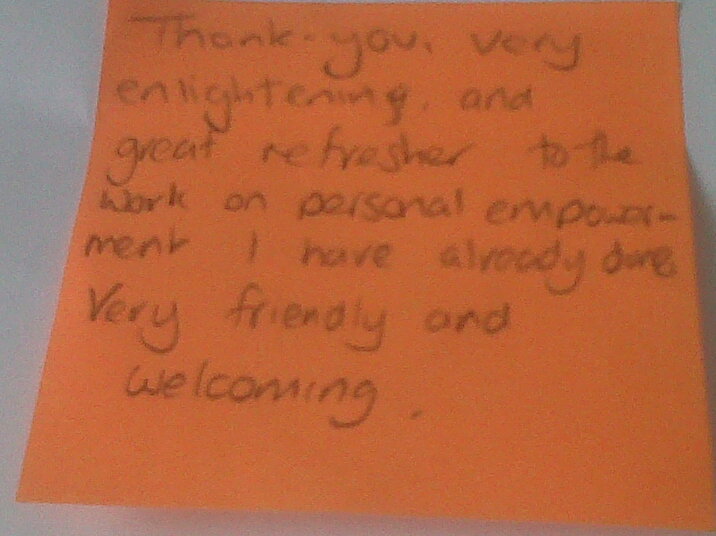
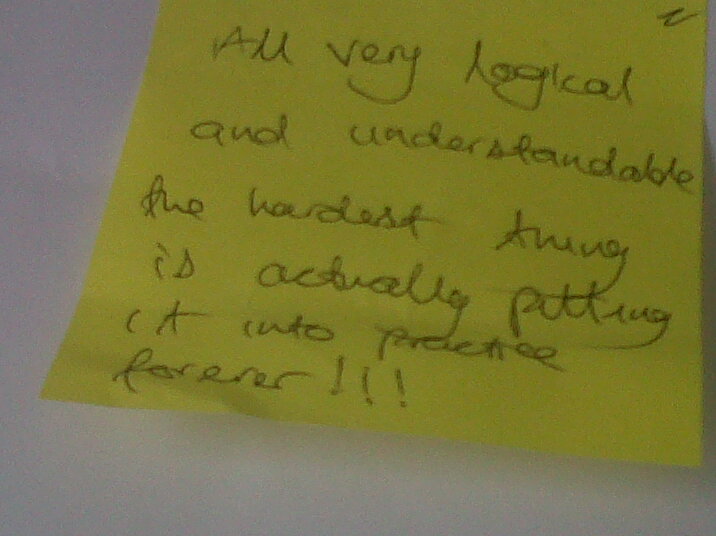
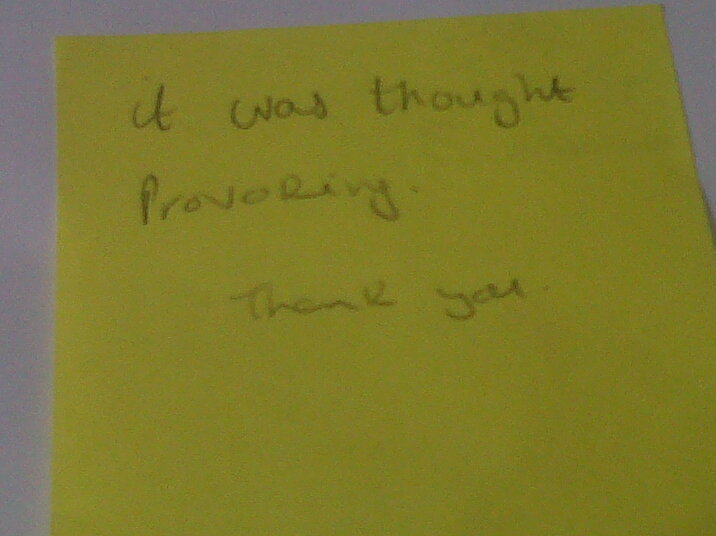
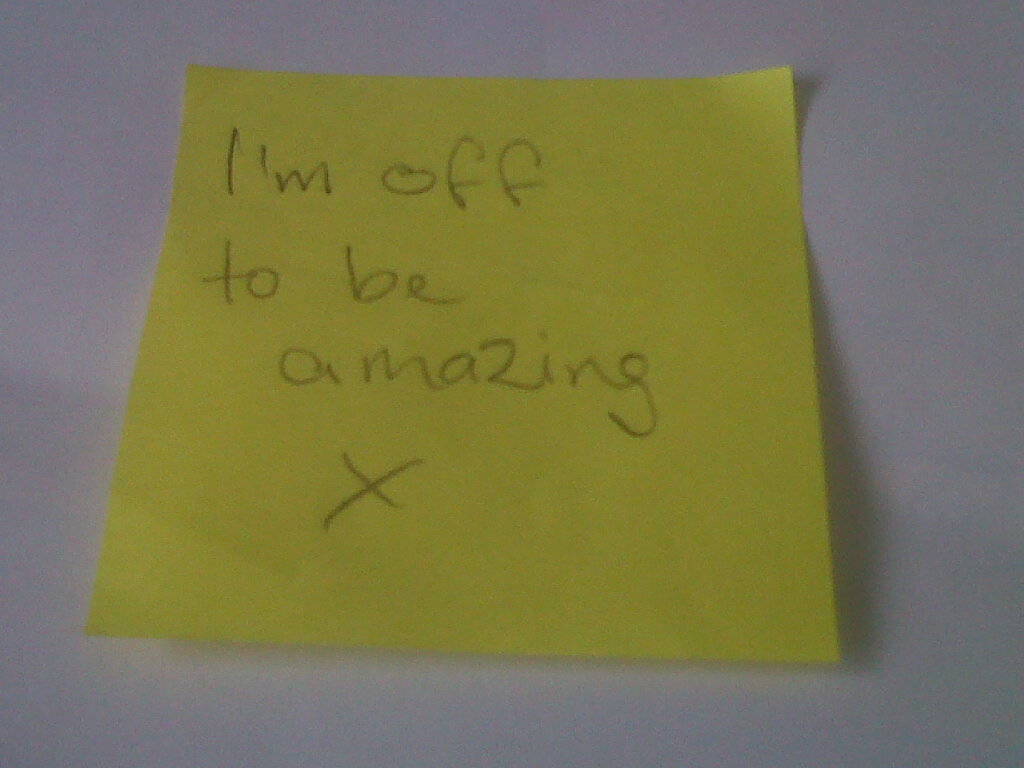
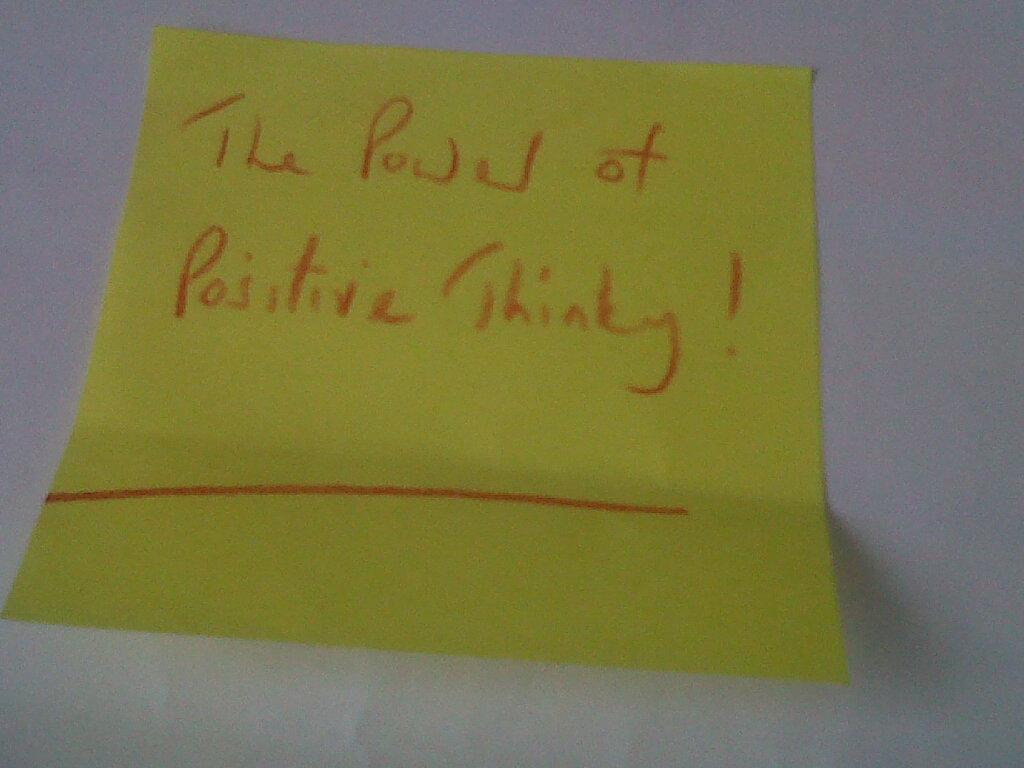
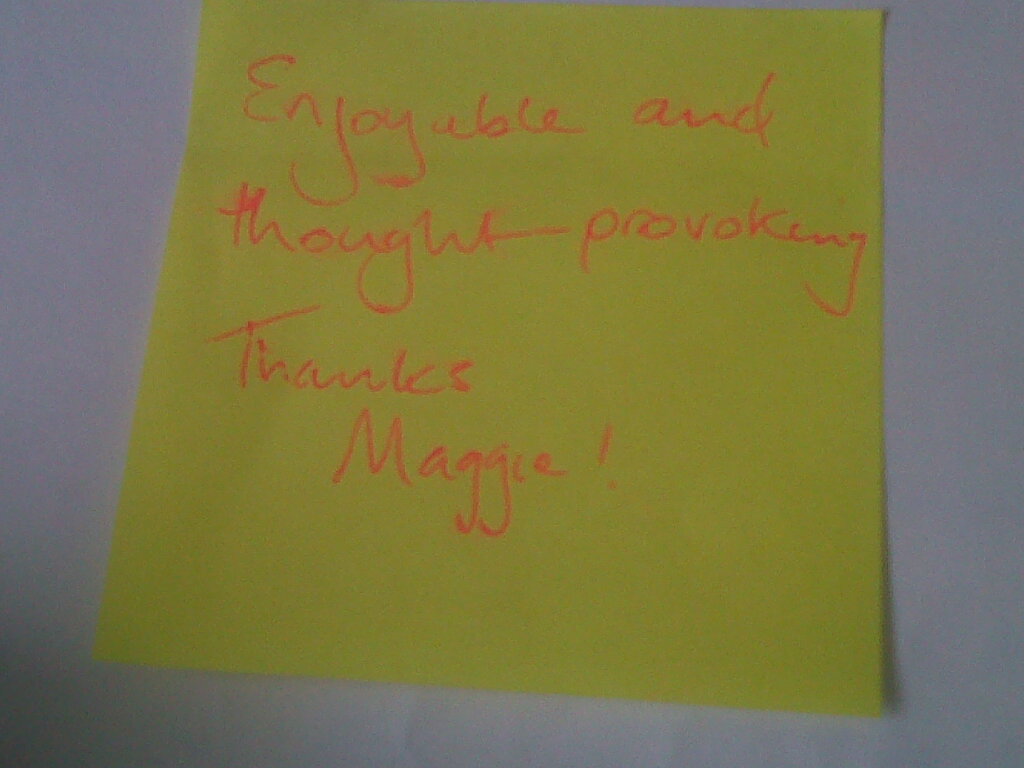
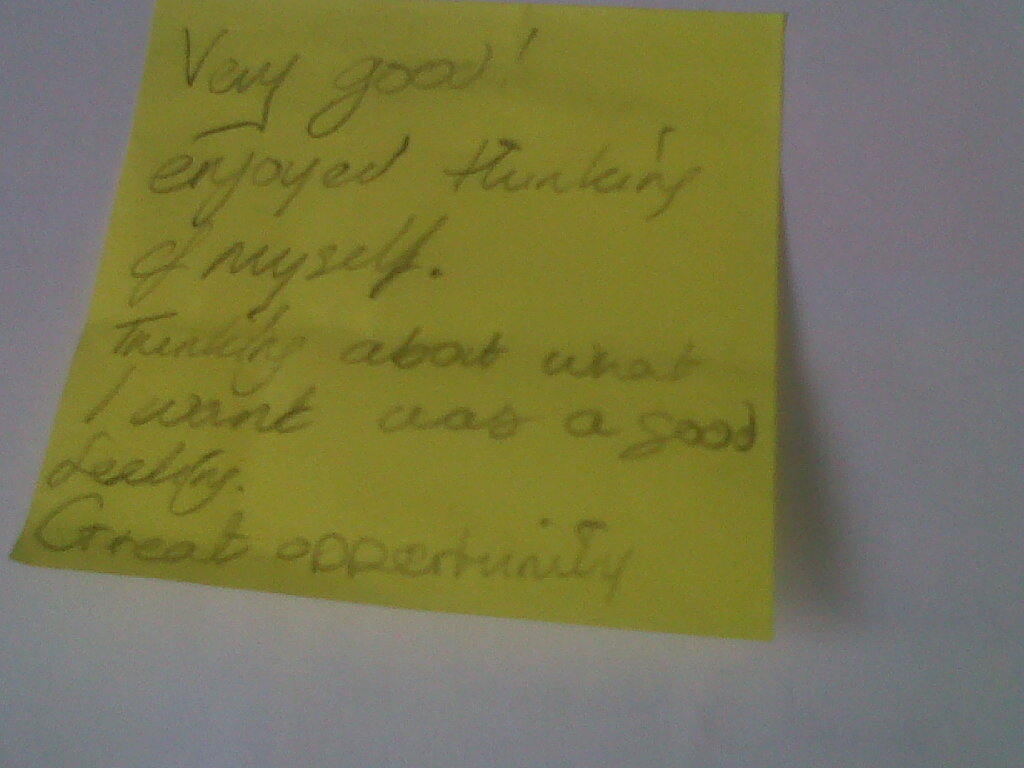
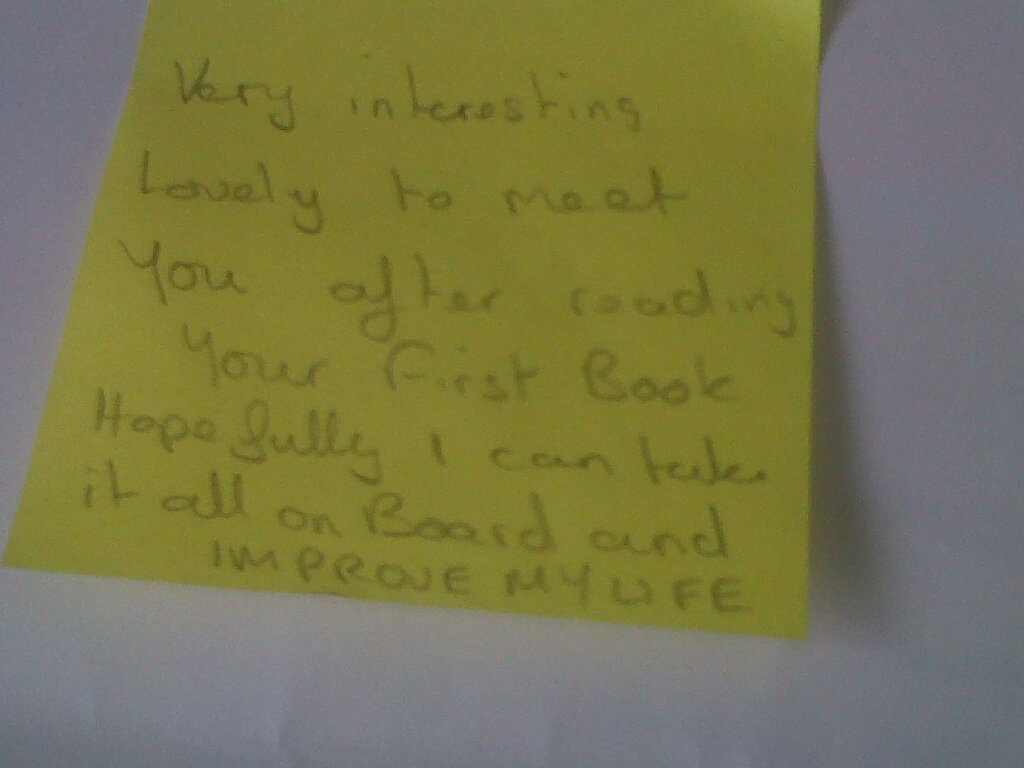
Here is some of the feedback from the attendees

IMG00412-20140521-1327                         IMG00411-20140521-1327            IMG00410-20140521-1327


I had taken a lot of time and trouble to prepare the workbooks for the workshop.  I included a recommended reading list, information on how to construct and use affirmations, all the exercises and some homework.

IMG00409-20140521-1327                      IMG00408-20140521-1326              IMG00407-20140521-1326


The homework exercise is to write 50 good things about yourself.  This can be done by writing 3 things a day until 50 are reached.  It is then a good thing to be able to read all the lovely things you have written about yourself and remind yourself just how good you really are.

IMG00406-20140521-1326                    IMG00405-20140521-1325                  IMG00404-20140521-1325


My next workshop will be on Monday 15th September 2014 and will be about your relationship with yourself.  Keep an eye on my website for sign up details.

IMG00403-20140521-1325                    IMG00402-20140521-1325                 IMG00401-20140521-1324

The attendees achieved a lot in a very short space of time, just imagine what they will achieve over a few months of coaching. The possibilities are endless.

 Contact me today to have a free chat on how my coaching will help you to change your mindset.


Maggie Currie

maggiecurriecoaching_logo8-2.jpg

Follow me on:

Website

Facebook

Twitter

LinkedIn

Huffington Post


What makes you laugh?

I was sitting and wondering what to write, and then it came to me – what makes me laugh?

The things children say that are so honest and innocent – for instance my granddaughter, who is 11 years old now, was asked when she was about 18 months old to go and do something with her mother. Her reply was ‘I haven’t finished yet’. When asked by her mother what she was doing that she hadn’t finished yet, my granddaughter replied ‘Looking out of the window’. Now that made me laugh, because it was so cute, so innocent and so honest.

My husband makes me laugh on occasion. Sometimes it is something he says, sometimes it something he does, it could just be the expression on his face.

Dogs make me laugh by the way they run around in circles trying to catch their tails, or chase leaves or each other.

dogwithball

Monkeys with their antics, squirrels playing with their acorns, horses trotting around their fields.

My face in the mirror first thing in the morning is just hilarious.

I love to watch people and often the way they behave makes me laugh. It could be that they are tipsy and giggly, or they have a specific way of packing their shopping into their bags, they have to put things in a particular place.

laughing

Laughing doesn’t mean I am ridiculing, it means that I am enjoying what I am seeing and feeling. I love people and animals. I find them fascinating and intriguing.

So lots of things make me laugh, sometimes inwardly and sometimes with a full on belly laugh. The latter is extremely good as I can feel my mood shifting too. Having a good laugh is rejuvenating.

Have you noticed, going through life traumas, illness, divorce and beyond, that you don’t laugh as much? What could you do to change that?

 Contact me today to have a free chat on how my coaching will help you to change your mindset.

Maggie Currie

maggiecurriecoaching_logo8-2.jpg

Follow me on:

Website

Facebook

Twitter

LinkedIn

Huffington Post

Bouncing back

Life happens. It doesn’t matter how positive, balanced and centred you are, there are going to be times when you are knocked sideways. Times when your carefully organised life is turned upside down and you get knocked for six. Life happens!

You may be challenged with any number of situations that will leave you feeling like you were kicked in the stomach. It may be the loss of a loved one, a divorce, the loss of a job, bullying or the plain stupidity of some people who affect your life.

Let’s face it. Things happen. They’re part of life and although I know that “everything happens for a reason,” things still hurt. And they hurt a lot! They hurt at the very core of your being. The pain begins in your heart and radiates throughout your entire being.

womanscreaming

At times like these, you may feel down, possibly depressed. You may feel anger or some other manifestation of your pain. You may feel out of control and that life will never get better. Whatever you’re feeling, it’s ok. It’s ok to feel hurt, sad, angry, used, miserable or whatever your true feelings are. You cannot deny pain any more than you can deny fear. The only way through this is to give yourself permission to feel the feeling.

The question is not whether or not you will feel down. The question is for how long will you stay in this state?

The difference between people who get through life’s challenging moments, regardless of the seriousness, and those who are immobilised by the events is their ability to bounce back. That isn’t to say they care any less, they give themselves permission to move on.

How quickly can you bounce back?  Of course, the severity of the event will have a lot to do with the time it will take you to get past the pain and on with your life.

Take the example of two people being downsized from their job, something that is becoming a common occurrence these days. One is floored by the news of her dismissal. She expresses her pain by becoming angry at her employers, her colleagues and the system in general. She spends her days telling anyone who’ll listen, about her “problem” and how hard done by she is.  And usually from a bar stool!

As she sees it, her life is ruined and she’s blaming everyone for her troubles. People who react like this spend weeks, even months, wallowing in despair until, if they’re fortunate, someone close to them convinces them to seek professional help.

On the other hand, the other person reacts very differently. Although they have gone through the same experience and have pretty much the same issues like living expenses, etc., they choose to react differently.

After a brief period of feeling a loss of self-esteem, self-pity and anger (quite naturally), they decide to get back in the game. They begin contacting their network of colleagues and friends, avail themselves of courses and other services their former employer offered everyone and starts actively looking for a new position. In a short time they find their “dream job” with an exciting new company.

While both people in our hypothetical example had the same experience and both went through a period of hurting, the time each allowed themselves to remain in that dis-empowering state was vastly different. While one remained “stuck” in their problem, the other handled their loss and moved on with their life.

A caucasian college student talking on the phone

This is the key. It’s not whether life occasionally puts you into a tailspin, it’s how long you choose to remain there.

When something devastating happens to you, allow yourself some time to grieve your loss, that is essential.  However, don’t allow yourself to get stuck there. Take some action. Join a support group, talk about your feelings with a trusted friend or a professional.

In the case of a job loss, perhaps you might want to take some time to re-evaluate your career goals. You may even consider a change in career altogether. When you’re ready, you can begin networking and making new contacts.  Attend social or networking events. Call people you know. Do something!

One of the most important things to remember in high stress situations is not to allow yourself to become isolated. While spending some time alone is normal, even necessary, isolation can be dangerous and should be avoided at all costs. Get out and be with people as soon as possible.

Remember “life is for the living.” It’s important to get back to your life. In time, the pain will pass.

Contact me to have a free chat on how my coaching will help you get back on track.

Maggie Currie

maggiecurriecoaching_logo8-2.jpg

Follow me on:

Website

Facebook

Twitter

LinkedIn

Huffington Post


Fear of crowds

Fear of crowds is very common for a lot of people whether they are single, married, male, female, high flyers, students, teachers, old or young .

I know how it feels to be alone in a crowd. I often feel totally overwhelmed in a large crowd of people, especially if I don’t know anyone in that crowd. It can feel like I am on the periphery and not allowed into the inner circle, and that, of course, makes the fear even worse. I wonder if the fear is actually of the crowds themselves or is it a fear of feeling lost or being unnoticed amongst a large number of people?

I know when I am in a large crowd of people entirely ‘on my own’ I feel nervous; I have an irrational fear that nobody will even notice that I am there.  I look at the little groups of people who do know each other within that large crowd enjoying themselves and the company of each other and that somehow increases my nervousness and the fear.  Of course they may feel just like I do but when I feel that fear, it certainly looks like they’re having a great time and I’m not. When I am in a large crowd of people and I have my own ‘group of people’ with me I feel safe and secure and know that I am noticed and therefore I don’t have those same feelings as when I am alone in a crowd.

Business people communicating with each other against white

Did you grow up in a house where “children were seen and not heard”? That might be the root of these feelings of nervousness and insecurity as they are for me. I can ultimately relate feeling like this to my childhood when I was constantly told that I should be seen and not heard.  So I would sit in the corner with my toys and only speak when I was spoken to.

Having worked hard on discovering my authentic self, discovering, acknowledging and accepting those unexpressed feelings and emotions of when I was told to be seen and not heard,  I now think and act differently.  I know there is a solution to this fear of crowds.  Based on what I know to be true about fear.  I know that FEAR is:

False

Expectations

Appearing

Real

I have found the solution that works for me and might work for you too:

  • Don’t worry about pleasing anyone else. Just be you.
  • Here’s what I do – I take a deep breath or two and take the plunge.
  • I walk amongst the strangers in the crowd and I expect to be noticed. I’ve decided not to expect to be or feel lost.
  • I make eye contact with people and smile at them.
  • I say hello to people I have never met before and strike up conversations.  They aren’t always long conversations, just long enough to introduce myself and be friendly and to listen to the other people.  Sometimes they are much longer, it depends on the person of course. Once the conversations start to happen, other people start to talk to me and to each other and before long I am part of the ‘crowd’ and not isolated on the periphery.

Even if being you just says it’s ok to not talk to anyone – which is a good friend of mine’s solution for her fear of crowds.  She’s decided to not push herself and just enjoys watching people. Funny thing is, she reports people come and talk to her.

winelady

So I know that I am not alone in feeling alone.  There are other people who are in the same position as me and I make a special effort to speak to them as well and include them in the conversations.  The energy and dynamics of the crowd change visibly and it becomes much more enjoyable.

The most important thing is to find a way to feel comfortable being you whether you decide overcoming the fear by talking to people is your way, or overcoming the fear by giving yourself a break and just allowing others to talk to you is your way. Bottom line, stop pressuring yourself to be like everyone else and just be you.

Contact me to have a free chat on how my coaching can help you find solutions to your problems.

Maggie Currie

maggiecurriecoaching_logo8-2.jpg

Follow me on:

Website

Facebook

Twitter

LinkedIn

Huffington Post


How do I know I have low self-esteem? And how can I change that?

Low self-esteem manifests itself in a variety of ways, and I should know I have been there.  For me the following was very true:

  • I didn’t think I was good enough.
  • I thought everyone else thought they were good enough.
  • I didn’t look after myself, I put others first.
  • I let people manipulate me.
  • I was in a bad relationship.
  • I felt sad and thought there must be more to life than this.
  • I constantly asked other people for their opinion, I didn’t think I knew anything.
  • I was verbally and emotionally abused and never felt I was worthy.

I started out with the intention of being happy when I got married at age 19, but soon discovered that the marriage was not working as I was constantly treated like an idiot, not allowed to develop as me, told I was worthless and became a possession.  This situation went on for 12 years and my self-esteem nose-dived.

emotionalwoman

 When I eventually woke up to the fact that I was allowing this to happen, I decided to get out of the relationship.

Getting out of that relationship led me to become a single parent, living in a small flat with three small children, no money, no job, no prospects and I felt there was no hope.  My self-esteem went down even further.

Does anything resonate with you yet? Can you see the likenesses in your life at the moment? Don’t despair, there is hope.

It took me a while, some years, but I found the answers to rebuilding my self-esteem and my life to such an extent that I now run two successful businesses that I set up and I am a published author. I married again and have been very happily married for 30 years to a wonderful man who loves me as me.  I have retrained as a life coach and work with people who have no self-esteem and help them to re-build it and I love every minute of it.

I know how it feels, I know it hurts and that’s why I can help so many people.  I am still learning, life is a school and I attend every day.

graduated

 So what can you do right now to begin to change your situation and start to re-build your self-esteem?

  • Stop thinking that you are not good enough.  You most definitely are.
  • Begin to look after yourself, put yourself first. It is not selfish – it is essential.
  • Before you think that you don’t have the answer stop, really think about the question, the answer is there, you just have to find it deep down inside yourself.
  • There is more to life than you have now, it is out there waiting for you. What is it that you want? Picture it in your head, write it down, look for it and you will attract it to you.
  • Listen to your intuition. Really listen. It is telling you what is right for you.

By changing your attitude towards yourself you will notice that other people will change their attitudes towards you.  It won’t happen overnight, it will take time, but it will happen.

Begin today to change your life. You deserve to be happy and to be yourself. You deserve to have high self-esteem.

Don’t be afraid to ask me for help in facing your fears and peeling back the layers. Trust me to help you find the real you. I’m not the same as every other Life Coach out there. I work from my heart, incorporate emotion based coaching and inspiration from my own life experiences. You can trust me to inspire you, encourage you, support you, nurture you along your path of transformation. Do it for you, do it today. Get in touch today to take your first steps towards a more confident and intuitive you.

Contact me to have a free chat on how my coaching can help you find solutions to your problems.

Maggie Currie 

MaggieCurrieCoaching_Logo8-2


Website

Asking me for help comes from a place of strength, not weakness

Many people find it challenging to accept help, and even more challenging for some to ask for help.  They somehow believe that asking for help they are undermining their ability to cope or they think they have failed in some way.  Some also believe that asking for and taking help from others is a weakness.

All of those ways of thinking, whilst totally believable, have been ingrained in us through conditioning.  I always remember my parents saying to me ‘You don’t need help, you are a big girl now, you can do it on your own’, or ‘Don’t be weak, get on with it yourself’.  Thus, I thought for a long time that I should be able to cope and that I didn’t need help.

Remember, there are no shoulds in this world.

tiredwoman

My parents believed they were doing the right thing, as they had been conditioned similarly by their parents.

Now is the time to bust those myths wide open!  Asking for help does not come from a place of weakness, it comes from a place of strength!

Being aware that you need help in some areas shows a positive way of thinking and is in no way a sign of weakness.  It is most definitely a sign of strength.  There is no stigma attached to asking for help, there are no hard and fast rules about how much people must be able to struggle on without asking for help.

Take for example a shop owner.  He/she opens a shop selling widgets and they become so popular that in a few short months the shop owner finds that going to the market to buy the widgets, stocking the shop, selling and answering customer queries on the phone is all too much.  Without help the shop will most certainly fail, as customers will go to another shop where they perceive they are getting better service.

The shop owner needs to know when to ask for help, either by hiring a shop assistant or a buyer, or perhaps both.  The business will then go from strength to strength as the customers will have their widgets, the shop owner can get on with selling them, and the buyer can get on with buying them.

Asking for help will find the solutions you are looking for.  Burying problems is a sign of weakness and is the same as running away from the problem and hiding.

You also need to trust that you are worthy of receiving help and, of course, trust the person you go to for help.  There are many exploitative people out there and you will detect them easily.  Remember, it is about their karma, and not your worth.  They will move away from you once they are discovered.

Pretty woman portrait

 Don’t be fooled by the illusion that all problems are easy or that problems needing solving only apply to some people and not you.  Never apologise for your need for help.

It is a good idea to prioritise your problems and your need to ask for help.  If you can fix a problem on your own effectively then do it and reward yourself.  However, if you have a problem where you can’t find a solution on your own, then ask for help.

There will be problems that nobody can fix.  And there lies the greatest strength of all – letting go of that problem.  Accept there is no solution and let it go.

Ask me for help with problems you may have in parts of your life.  There is no stigma, it is a sign of strength and it is my life’s work to help other people to find solutions to their problems.  Don’t ever be afraid to ask me for help.

Contact me to have a free chat on how my coaching can help you find solutions to your problems.

Maggie Currie 

Creedence – Confidence for You

Coaching you to become the very best version of you so you can have more fun, live a better life and enjoy your work.


creedence.jpg

Website

Facebook

Twitter

LinkedIn

Huffington Post


Noticing your feelings and defining the reaction taking place within you.

It is common knowledge that feelings can often bring about a very challenging aspect to our lives. We can experience very intense emotions without understanding precisely why. Consequently we can find it difficult to identify those solutions to relieving our distress, calming our minds and understanding why we are experiencing these emotions.

When we have mastered the ability of naming our feelings we can then tame them by finding an appropriate resolution. We are able to retake control of our personal power by becoming courageous enough to recognise and articulate, out loud and concisely, the essence of our emotions.

Once we assume ownership of these challenges we are empowered to shift from one emotional state to another — and with the added bonus of letting go of pain and upset because we have made it our own by defining it, examining the effect it had on our lives, and exerted our authority over it by making it our own. Additionally, by naming our feelings, we claim the right to divest ourselves of them whenever we choose.

womanscreaming

When you are preparing to acknowledge your feelings aloud, take care to remind  yourself gently that being specific is an important part of exercising control. It doesn’t matter what the nature of your feelings is, define very carefully the reaction taking place within you.

For instance, if you have a fear of a particular situation or are intimidated by an individual, endeavour not to mince your words while giving voice to your anxiety. The precision with which you choose to express yourself is indicative of your overall willingness to stare your feelings in the face without flinching. Naming and claiming may not always work if you keep this information to yourself. There will be occasions where you will find the release you desire achieve will only be found by admitting your feelings to other people. When this is the case, your ability to outline your feelings explicitly will help you to ask for the support or guidance you need without you becoming bogged down in the feelings that led you to make this admission in the first place.

So how do you identify that you have a particular feeling or emotion, and how do you define the reaction taking place within you?  Sit down quietly, close your eyes and ‘listen’ to your body.  What is it telling you?

For instance, do you feel a strange sensation in your stomach, or is there an uncomfortable sensation in your back, neck, arm or somewhere else?  Focus on what you notice, really focus and allow it.  Keep focusing on it and you will notice that once you have allowed it, the strange or uncomfortable sensation will gradually diminish and then disappear.  But not before you have associated it with the feeling or emotion that had caused it.

happyladywithbook

When you have moved past that slight apprehension associated with expressing the feelings that are causing you distress out loud, you will be surprised to discover that you feel both liberated and lightened. This is because you have made a clear connection between your feelings and what is causing them allowing you to unravel the mystery that previously kept you from being in complete control of your emotional state.

The process of giving voice to your feelings allows you to let them go. Once you have let them go, you will naturally relax and rediscover your emotional equilibrium.

Contact me to have a free chat on how my coaching can help you understand and embrace your emotions.

Maggie Currie 

Creedence – Confidence for You

Coaching you to become the very best version of you so you can have more fun, live a better life and enjoy your work.


creedence.jpg

Website

Facebook

Twitter

LinkedIn

Huffington Post


Improving your body language can improve your confidence!

The way that you move your body and how you walk has an enormous effect on the way that you feel and affects your confidence levels.

Lets start with an exercise.

Imagine there are two people standing in front of you – one with “negative body language” and one with “positive body language”.  I’d now like you to write down what you are observing with each of these people

                                                                                                                           Positive/Negative

  • How are they standing?
  • Where are their eyes looking?
  • What position are they holding their head?
  • How are they talking?
  • How are they moving?

How you feel at any moment in time is linked to what is going on in your mind and how you are moving your body. The way that you move sends subconscious messages to your mind and this either helps or hinders the way that you feel.

Emotion is created by motion. If you sit still for a long period of time your natural energy levels automatically lower. And what happens when you get up, walk around and return to your seat?  Yes, you have more energy and you’re given a boost.

I can’t stress how important it is to move and act confidently and positively. You will give off all the right vibes to everyone around you and it will make them think that you are confident even if you’re not feeling it inside. Yes, that’s right. Even if you’re not feeling confident, act as though you are.

??????????????????????

So, how do you do this?

  • Walk swiftly and with a purpose. Don’t saunter along, walk like you know exactly where you are going and when you get there you mean business!
  • Gesture with your hands as you talk, it will create motion and you know what that leads to – EMOTION! The right gestures also have a major impact on building rapport as long as you’re not shaking your fist!
  • All it takes is a smile!  Think for a moment about your confidence role model. One thing that she and confident people in general have in common is that they all probably smile a lot and are happier than their negative counterparts. It may sound silly, but there is a lot of power associated with a smile.

Start smiling more often. Now, that doesn’t mean that you have to walk around with a silly grin on your face all of the time. But smile as you walk down the street, when you talk to someone, even when you look in the mirror at yourself. You will be surprised at how much better you will feel for it, and it will project a positive image to all others – one that will attract opportunities and people.

Remember that confident people are happy people and negative people are not. Happy people are also seen as more attractive than unhappy and sad people, so that is an added bonus!

New for 2013. From confusion to clarity – Becoming ME again

You know, the way that we communicate in our appearance, posture, gesture, gaze and expression can be such a powerful tool in the way that we feel and when communicating with others. The manner in which you communicate and your interpersonal skills are also very important indeed. Effective communication is vital if you are going to succeed no matter what you are doing.

The way in which we communicate with people is broken down into component parts, and it is popularly believed that people to whom we are speaking understand what we say by interpreting these different elements in varying proportions:

VERBAL – 7% of our message is interpreted from the words we use.

VOCAL – 38% is picked up from our voice – speed, tone , pitch, rhythm etc

VISUAL – 55% is what the other person sees – our body language

Please bear the above in mind when you are communicating to people.

If you are ever feeling down, just have a look at your body language and change it immediately. Even if it has to be false – YOU WILL start to feel better and more confident immediately.

First impressions count – notice body language. You can normally tell what others are feeling by the way that they are moving and using their body too. You can use this to your advantage when you are more aware of it.

Contact me to have a free chat on how my coaching can help you improve your confidence.

Maggie Currie 

Creedence – Confidence for You

Coaching you to become the very best version of you so you can have more fun, live a better life and enjoy your work.


creedence.jpg

Website

Facebook

Twitter

LinkedIn

Huffington Post


How to experience ‘Happiness’

Do you really know what will it take to make you happy? Think about it and see if you can discover what it will take for you to be happy?

  • Will being in a relationship, or with the right boyfriend/girlfriend make you happy?
  • Will being married make you happy?
  • Will having a million pounds make you happy?
  • Will being successful make you happy?
  • Will having better health make you happy?
  • Will getting a new job make you happy?
  • Will having a great career make you happy?

If you think the answer is yes to any or all of the above questions, you’ll never find happiness!

Surprised? Well don’t be. The truth is nothing can ‘make you happy’. Happiness is something you feel, not something you can find.

happy woman


Being happy doesn’t depend on a particular outcome or something happening to you. There isn’t somewhere you can go and find happiness sitting there waiting for you.

Advertising of all sorts is designed to make you think that a new car, a particular skin cream, a new outfit, some new shoes, a drink or a new diet will make you happy, but that is simply not true. Nothing can make you happy because happiness is a feeling. Happiness is something you experience.

If you want to be happy, then be happy. Most people don’t choose to be happy because they spend most of their time focusing on what they perceive is wrong with their life.

Think about it, you can’t be happy doing something that you don’t like. If you don’t believe me try it. Try doing something you despise and see if you can be happy at the same time. Trust me, you won’t be happy doing something you don’t enjoy!

You also can’t do something you really enjoy and be sad or angry. Don’t believe me? Try it. See what happens. Go and try doing something you really enjoy and see if you’re angry or miserable at the same time. That really won’t happen.

Unfortunately, people believe they can be happy when they achieve a particular goal and make the mistake of chasing that goal in order to be happy. It’s really not achieving the goal that makes them happy. It’s the feeling of achieving the goal that provides another feeling, satisfaction perhaps,  that is mistaken for happiness.

This mistake is quite common, because it’s not security or peace of mind that makes you happy. You experience happiness when you do what you enjoy and when you focus on the positive things taking place in your life. If you’re not doing that then you can never be happy.  Don’t think that you can be happy just by having something.

You can experience happiness by achieving your particular goal,  by doing what you enjoy, having fun while achieving your goals and choose the right goals for you, the kind that allow you to be happy all the time.  Focus on what you want.

Start doing the things that you enjoy. Look at the positive things that are going on in your life. Direct your mind and subconscious mind to help you experience happiness every day. This will start once you begin to appreciate the good things in your life.

Okay so how can you begin to be happy? It’s really quite simple, all you have to do is shift your focus.

‘Get back to me retreat’ Friday March 15th to Sunday March 17th 2013

Instead of looking at all that is wrong with your life, instead of looking at what you don’t like about yourself or your life; constantly criticising; change your focus. Start appreciating all that is good in your life. Envisage your life in the future.

Make a list if you want and write out all of the positive things in your life. Usually someone will say: “Maggie, I can’t think of anything positive or good in my life. I just want to be happy.” That’s only because they are not seeing all the positive things in your life.  And so you’ll never be happy.

Every day there are wonderful things taking place in your life, yet you fail to observe and recognise them. You tend to take them for granted.  This can be anything – a hot  meal, a wonderful spouse, family, a beautiful flower, lambs playing in a field –  If you have a roof over your head, that’s a positive aspect of your life.

Start looking at all of the great and terrific things that are going on in your life and you’ll begin to experience happiness on a deeper level. You can begin to improve or change the areas that you are not happy with but at the same time you should acknowledge the good things that are going on in your life.

Your mind is used to only paying attention to what is going wrong and in the process it directs the subconscious mind to continue creating more of those things that are going wrong. You actually create more of what makes you unhappy.

Why?

Because your subconscious creates what you regularly think about. So if you don’t regularly focus on the positive things you won’t create positive situations in your life.

And here’s where it gets worse.  When you constantly focus on what is wrong with your life, when you only think about and see what is wrong in your life, your subconscious begins to create more of what is wrong or more of what you don’t want because it thinks that you want more. It responds to your focus.

Now you know why it can be so difficult for some people to truly experience happiness, it’s because they’re used to focusing on the negative aspects of life and in the end continue to create more of what they don’t want.

In order to change all of this you have to begin training the mind and re-directing the subconscious mind to begin creating what you want in life and to focus on the good things that are taking place in your life.

Begin experiencing happiness by changing your focus. Everyday think of the positive things that are going on in your life. Make a list of all the wonderful things that are taking place in your life.

Think of at least 3 great things that happened to you they can be small or large – but just appreciate 3 good things that happened during the day. Do this every day for a month and you will see your list grow.  Focus on the positive. Direct your mind and subconscious mind by changing your perspective so you experience happiness everyday

Too often I hear from people who simply want to be happy but when I ask them what they do for fun they say: “Nothing.”  No wonder you’re not happy. How can you be happy if you’re never having fun in life?

tyre swing

If you want to experience happiness then start doing things that you enjoy.  You may like gardening; you may like hang gliding, you may like riding your bike, you may enjoy going for long walks, you may enjoy acting like a 5-year old – whatever it is start doing it and see how great you feel.

But there is one catch when you’re doing what you enjoy, you can only focus on that and not think about anything else that may be bothering you. That’s the only way you’ll truly enjoy the activity and begin to experience happiness.

As adults we get bogged down with the everyday tasks that force us to be serious. We have jobs where we’re serious, bills to pay, food to prepare, children to look after, it’s all too serious and it is necessary. I’m not suggesting you ignore your responsibilities – but take some time just to have some fun.

Now you can’t just have fun once a week or once a month. You have to do this every day. That means every day you have to find something fun to do, and only then will you get comfortable and used to the process to the point where you regularly experience happiness. Once you start doing this you’ll enjoy it so much you’ll wonder why you never did this to begin with.

If you don’t feel you have the time to have fun and enjoy your life then you’re really saying that your happiness is not important enough. Only when you decide to be happy will you truly begin to experience happiness. You can work with the techniques I’ve outlined – they will help you get started. But you will need to train your mind and subconscious mind to begin seeing and living in a different way.

Contact me to have a free chat on how my coaching can help you on your road to happiness.

Maggie Currie 

Creedence – Confidence for You

I am coaching people to become the very best version of themselves so that they can have more fun, live a better life and enjoy their work.


creedence.jpg

Website

Facebook

Twitter

LinkedIn

Huffington Post

How to Develop a Positive Self Image in Negative Situations – Guest Blog by Lanre Solarin

It’s very easy to be overwhelmed by our problems, especially when we feel no one else is going through the same thing.

So we separate ourselves, and then either suffer in silence or bask in self pity. We tell every Tom, Dick and Harry about what we’re going through so that we’ll receive a response like, “Oh, I’m so sorry for you. It’ll be alright, okay?”

That’s one classic statement that most of us love when we’re in negative situations. But guess what?

It gets you nowhere.

Why? Because negativity doesn’t add a tint of positivity to any situation, no matter how much you “hope”.

Self pity is not a positive thinking exercise that helps you solve problems. It only allows people to sympathize with you, without giving you any actionable solutions. But unfortunately, it’s the therapy that many of us take when we suddenly end up in a bad debt or with a terrible relationship.

It gives us such a negative self image that we stop seeing the problem as something that will pass.

We begin to see that problem as if it belongs to us. This is real identity crisis. And when it gets to this stage, it means that our beliefs have been adversely affected and our image disrupted.

But there’s hope. Negative situations don’t always have to lead to negative personalities.  We don’t always have to react to bad things as though the world is coming to an end.

All you need to do is learn to see yourself in the positive light. You need to learn to see the light at the end of the dark tunnel and then walk through it. Here are 3 ways to develop a positive self image even in the most negative of situations.


1. Refuse to Pity Yourself by Hating the Problem

Self pity keeps you stagnant and doesn’t drive you to try and solve the problem. On the other hand, taking action by seeking for advice gets you going from the problem spot. When I discovered that I had been plagued by inferiority complex for the first 17 years of my life, I had two choices: to feel sorry for the timidity I felt or to kick it to the curb.

The only way you can seek for a solution is to hate the problem you’re in, but not yourself. Instead, you need to love yourself so much that you wouldn’t want to associate yourself with that problem for a long time.

No matter how terrible the situation may be, you can push yourself to become a solution seeker rather than a problem carrier. To do this, ask yourself just one simple question, “Is this how miserable I want to be for the rest of my life?” If you answer “Yes” to that question, then stop reading. But if it’s a huge “NO”, watch how you’ll start to hate the problem you’re in.


2. Seek For a Solution by Being Aggressive

There are two types of aggressiveness: the misdirected one caused by the frustration of not achieving your unrealistic goals and the positive one which serves as a drive for success. The first type of aggressiveness is the reason why many people end up in self pity in the first place. The only way to seek for a solution to that problem you’re in is to make aggression your drive.

You must be ready to take “no” for an answer and not stop till you get what you want. You’ll need to start telling your sympathizers to stop being sorry for you and start giving you advice on how to get rid of the problem. You’ll need to make it clear to everyone that you’re not a victim of circumstance and that you won’t be in that mess forever.

To really do this, you’ll need to stop seeing yourself as someone who deserves to be pitied. Change your perception of yourself from that of a loser with no hope to that of a winner who can have everything working fine. Change your thinking from, “I can’t do this”, to “I can do this”.


3. Experience Gradual Success by Breaking up the Problem

Some problems are so huge and tough that it seems almost impossible to get out of them. But the good thing is that it’s never totally impossible. So what happens when you’re in a huge mess and you’re beginning to feel doubtful as to whether you’ll solve it or not? What you need to do is break it up.

The fact that you’re human means you have the ability to solve any problem you find yourself in. But to make things easier on yourself, you’ll need to start seeing the problem, not as just one huge mountain, but as a combination of rocks. Every problem can be taken apart piece by piece.

Assess that problem and determine the different things you need to do to get it solved. Divide it into steps and then make the accomplishment of each step a goal. As you complete each step and achieve each goal, let that be your drive to achieving the next one. This will help you to expect success at each step.

Being positive in the midst of negativity is not an easy task, but it’s a possible one. And it all starts from you making up your mind to become positive and then stay positive all through, regardless of how bad things may turn out.

The first step is always to make the decision to change. But after that what happens? You then manage that decision by following the three steps above. Refuse self pity to the extent that you start to hate the problem. This will help you aggressively seek out a solution and when you finally get one, approach it gradually.

By doing this, you’ll feel much better about yourself all the way and you’ll discover that nothing is too big that it cannot be solved. Even if the problem is so tough that you can’t chew on it, lick it instead :).


Lanre Solarin was once extremely negative about life until he encountered positive experiences that changed everything. You can grab a free copy of his report- Simple Steps to Positive Thinking to discover simple ways to Experience Positivity and change your life.